Why Did My Solar Panels Stop Producing? (Florida Troubleshooting Guide)
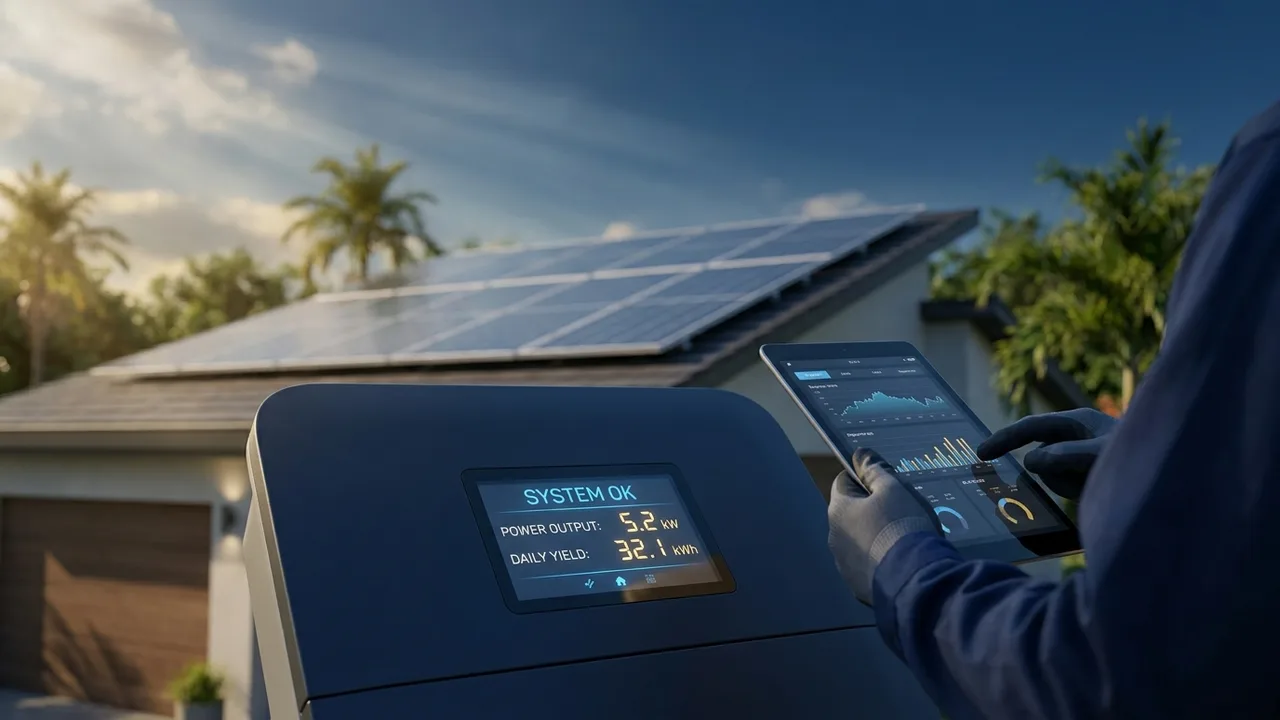
- Usual suspects: tripped breaker, inverter fault or failure, grid outage, or lost Wi-Fi/monitoring.
- Roughly 75% of service calls are inverter or communication issues, not the panels.
- Check first: breakers ON, inverter lights, the monitoring app, any recent storm or outage.
- Florida angle: our summer grid flickers and lightning knock systems offline constantly.
- Still down after the basics? Get a professional diagnostic — any brand, any installer.
Where the problem usually is
About three of four residential solar service calls trace back to the inverter or comms — not the panels themselves. That's why we run diagnostics first.
Why did my solar panels stop producing?
When a system drops to zero or close to it, the panels are rarely the problem — they're the most durable thing up there. It's almost always something in the chain that converts, connects, or reports their power. The published industry data pins roughly 75% of residential solar service calls on inverter or communication issues instead of the panels. Here are the usual suspects, most common first. If you want the whole picture on upkeep and repair, start with our solar maintenance and repair guide.
Is it a tripped breaker? (Check this first)
A tripped breaker is the number-one reason a system stops cold. A surge, a grid flicker, or a loose connection can flip your solar breaker to OFF.
What you can safely check: look at your main electrical panel and your solar sub-panel — often a separate little box near your meter or inverter. If a breaker is sitting in the middle or fully OFF, go ahead and switch it all the way OFF and back ON once. If it holds, you're good. If it trips again, stop. A breaker that won't stay on is telling you there's a real fault back there, usually a loose connection generating heat, and that's a pro's job — not another reset.
Is it the inverter?
Your inverter turns the panels' DC power into the AC your house runs on. If it fails or faults, production goes to zero no matter how bright the sun is.
What to look for: a status light that's red or amber instead of green, or an error on the inverter's screen or app — things like Grid Fault, Over Voltage, or Isolation Fault. Those codes usually point at grid conditions, wiring, or an internal part. Some clear on their own; plenty don't. If you've got microinverters (Enphase) or optimizers (SolarEdge), one dead unit can knock out a single panel while the rest keep humming — so you see a partial drop, not a full zero. I decode the warning lights in solar inverter red light and error codes.
Is it just the monitoring — or is production really down?
This one trips up a lot of people. Sometimes the panels are producing just fine, but the monitoring app lost its connection and quit reporting. A dropped Wi-Fi signal, a new router, or a dead cellular gateway can all blank out your data.
How to tell the difference: on a sunny day, check whether your house is actually pulling less from the grid (your utility app or meter), or walk outside and see if the inverter itself shows production. If the inverter's working but the app's blank, it's likely a comms issue — fixable, and it means you weren't losing power after all. More on this in solar monitoring app not working.
Did a storm or grid outage do it?
Here in Central Florida, this is a big one. Grid-tied solar shuts itself off during a power outage — on purpose, to keep utility crews safe while they work the lines. So if the power blinked, your solar may have dropped offline, and depending on the inverter, it may not restart clean on its own.
Our summer thunderstorms, lightning, and grid flickers knock systems offline all the time from June into the fall. And after a real storm there's the physical side: a dropped inverter, a chewed or storm-damaged wire, water getting in. This is also exactly why folks who want power during an outage need a battery. If you've got a battery or Powerwall that didn't carry your house, that's its own diagnostic. We handle storm repairs across Leesburg and all of Central Florida.
Could it be dirty panels instead?
Sometimes a slow slide — not a sudden zero — is just dirt. Florida pollen, lovebug residue, and bird droppings can quietly shave an estimated 5-15% off your production, and NREL research found that rain alone won't wash pollen off panels. If the app shows a gradual decline instead of a hard stop, and the glass looks filmy, start with a professional cleaning before you assume the worst. A sudden drop to zero, though? That's electrical, not dirt.
What should I check, in order?
A quick homeowner run-through before you call:
- Breakers — main panel and solar sub-panel all ON (reset once; don't fight a repeat trip).
- Inverter lights — green is good; red, amber, or an error code is not.
- Recent outage or storm? — the grid may have knocked it offline.
- Monitoring vs. reality — is production actually down, or just not reporting?
- Glass — filmy, and it's a slow decline? Could be soiling, not a fault.
If it's still down after that, quit resetting things — you'll want eyes on it.
When should I call a professional?
Call when a breaker won't stay on, the inverter's showing a red light or error code, production's genuinely down and you can't spot why, or there's any sign of storm or wiring damage. We diagnose any brand, any installer — even if the company that installed your system is gone — hand you clear written findings with photos, and confirm your output is back before we leave. No guessing, no parts you didn't approve. Book a professional diagnostic, request a free quote, or call (407) 270-2542.
Frequently asked questions
Why did my solar panels suddenly stop producing?
Should I reset my solar breaker myself?
Why does my solar shut off during a power outage?
Is my production really down, or is it just the app?
Can you fix a system another company installed?
Serving solar owners across Central Florida
We clean, repair, maintain and protect solar systems throughout the region — any brand, any installer. Find your town:
Need a hand with your solar?
Service Solar Pros — any brand, any installer, across Central Florida. Call (407) 270-2542.
Get a free quote