How Do You Keep Birds Out From Under Solar Panels?
- Blocking them out beats scaring them off — critter guard mesh seals the whole edge so birds simply can't get under.
- Spikes, gels, fake owls, and shiny tape are short-term; birds get used to them fast, especially in the sheltered space under an array.
- Always clear, inspect, and clean the array before you seal it, so you don't trap an active nest or a chewed wire inside.
- Good guard clips to the panel frames with no roof holes, so your warranties stay intact.
- In warm Central Florida the nesting season runs long — seal before spring, or the moment you hear activity up there.
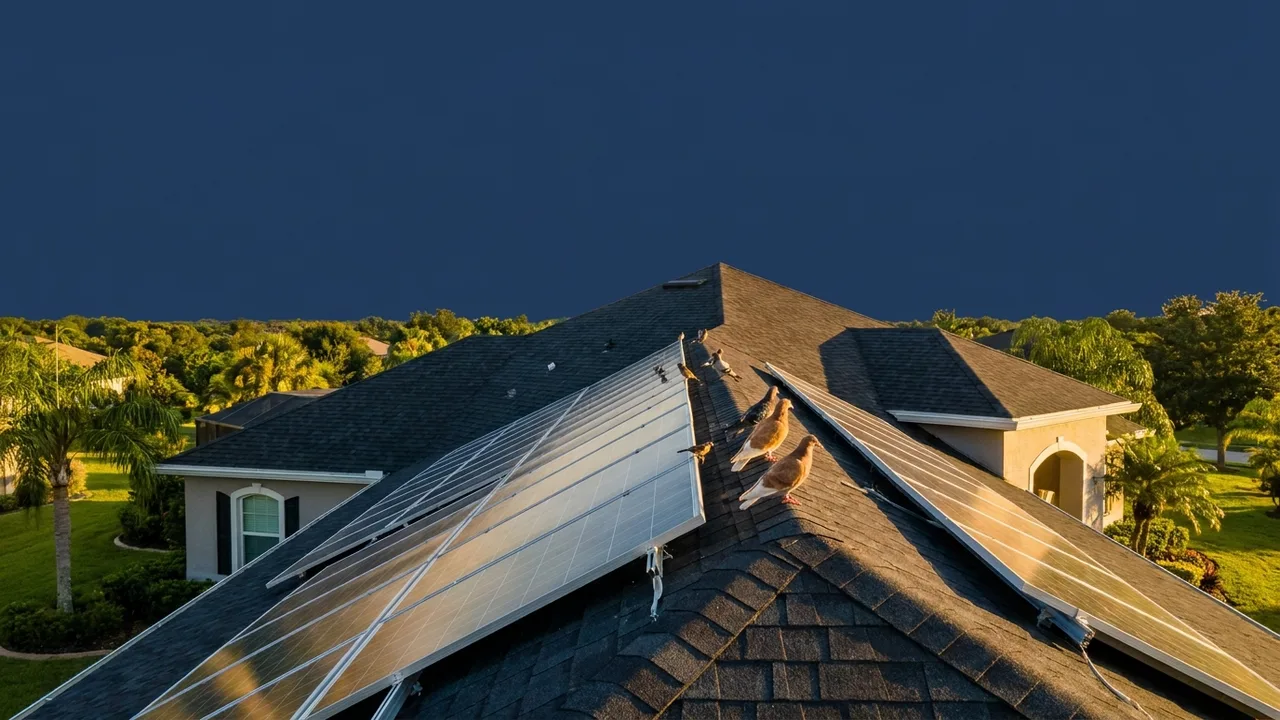
What ends up living under your panels
We clear them out, then seal the gap so they can't come back.
How do you keep birds out from under solar panels for good?
Straight answer: you block them out, you don't scare them off. You physically close the gap between the panels and the roof so the birds have nowhere to get in. That's what solar critter guard does — low-profile mesh clipped around the whole edge of your array. Once that edge is sealed, there's no warm hidden pocket left for a pigeon or a squirrel to move into, and the problem's over.
Everything else — spikes, gels, fake owls, ultrasonic gadgets, shiny tape — is a deterrent, and deterrents wear off. Birds are smart and they get used to things fast; once they learn the plastic owl never moves, they'll nest right next to it. Under a solar array, where they're already tucked away and sheltered, most of that stuff doesn't work at all. That's why pest-control folks treat mesh exclusion as the real fix and the rest as a band-aid. For the bigger picture, see our bird and critter protection guide.
What's the right order of operations?
Seal a dirty or occupied array and all you've done is trap the problem inside. The right sequence:
- Clear the area humanely. Get any active nest, birds, or rodents out first — done properly, and where the species and season call for it, within the rules.
- Inspect the wiring. Check the DC wiring and connectors for chew damage before anything gets covered up. If there's a fault, it gets a repair now, not later.
- Clean up droppings and debris. Get the acidic waste and nest material out so it isn't corroding the roof and equipment behind the mesh.
- Seal the perimeter. Then, and only then, the critter guard goes on around the full array.
Skipping the inspection is the mistake I see most. A homeowner clips mesh over a wire a squirrel already chewed, and months later the system faults — with the damage now sealed behind a barrier.
Do DIY bird deterrents work under solar panels?
Mostly no, or at least not for long. Here's the honest read on the common ones:
- Spikes: handy on a ledge, but they can't close the long open gap under an array, and birds just nest behind them.
- Fake owls and predator decoys: birds figure them out within days once nothing ever happens.
- Reflective tape and shiny objects: a quick startle, then ignored.
- Gels and sprays: messy, weather-limited, and they don't touch the sheltered underside at all.
- DIY mesh kits: right idea, but they tend to leave gaps at the corners, clips, and roof line — and birds find every gap. A clean, continuous seal is the whole point.
If you're weighing DIY, factor in the risk of falling off a roof, the health hazards in the droppings, and the plain fact that one gap anywhere in the seal blows the whole job.
Should I hire a pro or do it myself?
For most folks, a pro is the right call — not because the idea is complicated, but because the details are. Getting on a roof safely, catching hidden wire damage, cleaning droppings with proper protection, and sealing a continuous perimeter with zero gaps is exactly the kind of work that's easy to get 90% right and have fail at the last 10%. When we install critter guard in Leesburg and across Central Florida, the array gets cleared, inspected, cleaned, and sealed in one visit — and we service any brand from any installer.
How soon should I seal my array in Florida?
Sooner than you'd think. Central Florida roofs stay warm all year, so there's no cold snap to clear the birds out for you, and the nesting pressure runs most of the year. Best time to seal is before spring nesting ramps up — or the minute you hear cooing, scratching, or flapping under the panels. Waiting rarely makes it cheaper; it just piles on cleanup and, more often than not, a wiring repair. If you'd rather have it handled on a schedule with your cleanings, a maintenance plan keeps the perimeter check on the calendar every year.
Frequently asked questions
What is the best way to keep birds out from under solar panels?
Do bird spikes or fake owls work on solar panels?
Can I install bird mesh under my solar panels myself?
Should I clean under the panels before sealing them?
Serving solar owners across Central Florida
We clean, repair, maintain and protect solar systems throughout the region — any brand, any installer. Find your town:
Need a hand with your solar?
Service Solar Pros — any brand, any installer, across Central Florida. Call (407) 270-2542.
Get a free quote