How Much Do Bird Droppings Reduce Solar Panel Output?
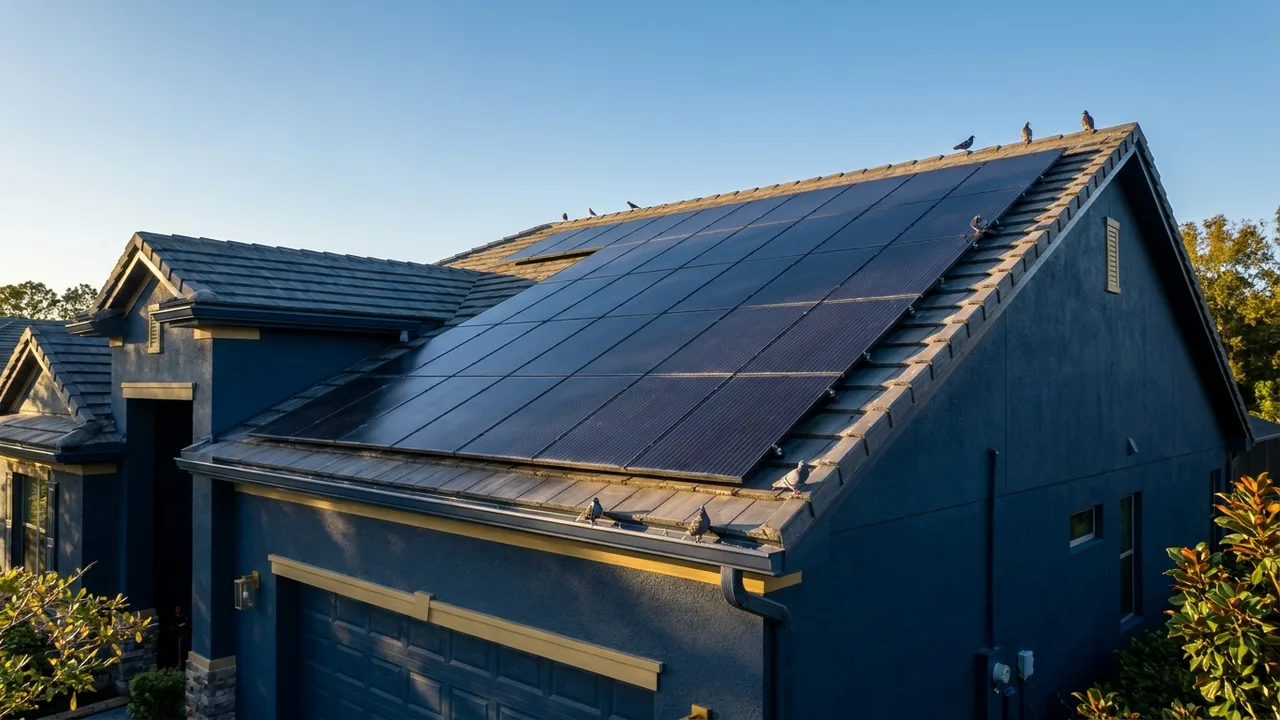
- A dropping doesn't just dim its own spot — because the cells are wired in series, one shaded cell can throttle the entire panel.
- That localized shading also creates hot spots that stress and can permanently damage cells.
- Droppings are acidic and corrode the glass coating, the frame, and the roofing over time.
- Unlike pollen or dust, rain won't rinse sticky droppings off — they need cleaning.
- Cleaning brings the output back; sealing the array with critter guard stops the droppings at the source.
What ends up living under your panels
We clear them out, then seal the gap so they can't come back.
How much do bird droppings reduce solar panel output?
More than the size of the mess would suggest. The instinct is to figure a dropping covering 1% of a panel costs you about 1% of that panel's power. Solar doesn't work like that. The cells in a panel are wired in series, like links in a chain, so the current running through the whole panel is limited by its weakest, most-shaded cell. One dropping sitting on a single cell can choke the output of the entire panel — a small mess causing a loss way out of proportion to its size. On some systems that loss keeps cascading down the string. It's the same reason a little shade in the wrong spot hurts so much. For the full context on protecting your array, see our bird and critter protection guide. Exact percentage loss varies by system design and how the droppings fall [VERIFY specific figures before citing a number].
What are hot spots, and why do droppings cause them?
When a cell is shaded by a dropping, it stops generating and instead starts resisting the current the other cells are still pushing through it. That resistance turns into heat, concentrated in one spot — a hot spot. Over time, repeated hot-spotting can permanently damage the cell and the materials around it, so the panel never fully recovers even after you clean the dropping off. That's why bird droppings are worse than ordinary dirt: they're opaque, they sit in concentrated spots, and they can leave lasting damage instead of a temporary dip. Hot spots are also a factor in panel faults that show up on your monitoring.
Do bird droppings damage the panel itself?
Yes, beyond the shading. Bird droppings are acidic, and left on the glass they can etch the anti-reflective coating and corrode the frame and mounting hardware. Down on the roof, that same acidity goes after your shingles, tiles, and membranes. And because droppings are sticky and concentrated, they bake onto hot panel glass in the Florida sun and get harder to remove the longer they sit. So the cost isn't just lost production today — it's gradual damage to the panel surface and the roof if you leave the mess in place.
Will rain wash bird droppings off my panels?
No — and this is where droppings part ways with pollen or loose dust. Light dust might rinse off in a Central Florida downpour, but bird droppings are sticky, protein-heavy, and usually baked on. Rain smears them instead of removing them, and can actually spread the shading around. They need proper solar panel cleaning with the right water and technique to lift them off without scratching the glass. And if you're seeing droppings back within days of a cleaning, that's the real tell: you don't have a cleaning problem, you've got birds living under the array — and cleaning alone will never keep up.
How do you fix and prevent output loss from droppings?
Two steps, in order:
- Clean to get the output back. A professional cleaning removes the droppings safely and recovers the production the shading was costing you — assuming no permanent hot-spot damage has set in.
- Seal to stop it recurring. If birds are nesting under the array, cleaning is a losing battle until you remove the source. Critter guard around the edge keeps the birds out so the droppings stop coming.
We handle both across Orlando and all of Central Florida — cleaning to recover your output and critter guard to keep it that way — on any brand of system, from any installer. A maintenance plan keeps cleanings and the perimeter check on one schedule, so your production never quietly drifts back down.
Frequently asked questions
How much do bird droppings reduce solar panel output?
Can bird droppings permanently damage solar panels?
Will rain wash bird droppings off solar panels?
How do I stop bird droppings from cutting my solar output?
Serving solar owners across Central Florida
We clean, repair, maintain and protect solar systems throughout the region — any brand, any installer. Find your town:
Need a hand with your solar?
Service Solar Pros — any brand, any installer, across Central Florida. Call (407) 270-2542.
Get a free quote